
Chapter 3
The Landscape
When you come up with an idea for an app, there's one very specific moment you want to get through as early as possible: the moment you search for it and find out it already exists.
It stings a little, and it happens almost every time. But it's good news.
In 2019 I wrote that it doesn't matter if something similar already exists, that it would be like Ray Kroc deciding not to start McDonald's because somebody else was already selling hamburgers. I still think so. If something similar exists, it means there are people with that problem. What you need to know is what the ones already out there are getting wrong, and where the gap is.
That's the landscape review.
Three kinds of competition
In the original book, the landscape review meant browsing the app stores and sorting what you found. That's still part of it, but I didn't go far enough. Your competition comes in three forms, and the one that's hardest to beat is almost never the first.
Similar apps. The obvious one. Other apps that do something close to what yours does. For Falta Uno: field-booking apps, apps for organizing pickup games, generic scheduling systems.
What people use instead of an app. This is the rival that matters. The WhatsApp group. Calling the venue. The notebook where Laura writes down the bookings in ballpoint pen. The shared spreadsheet. These things have a huge advantage over your app: they're already installed, people already know how to use them, and they cost nothing.
Doing nothing. Putting up with the problem. Playing four against five. Calling the game off. For a lot of people, the problem you see doesn't hurt enough to make them change their habits. If that's the case, no app is going to fix it.
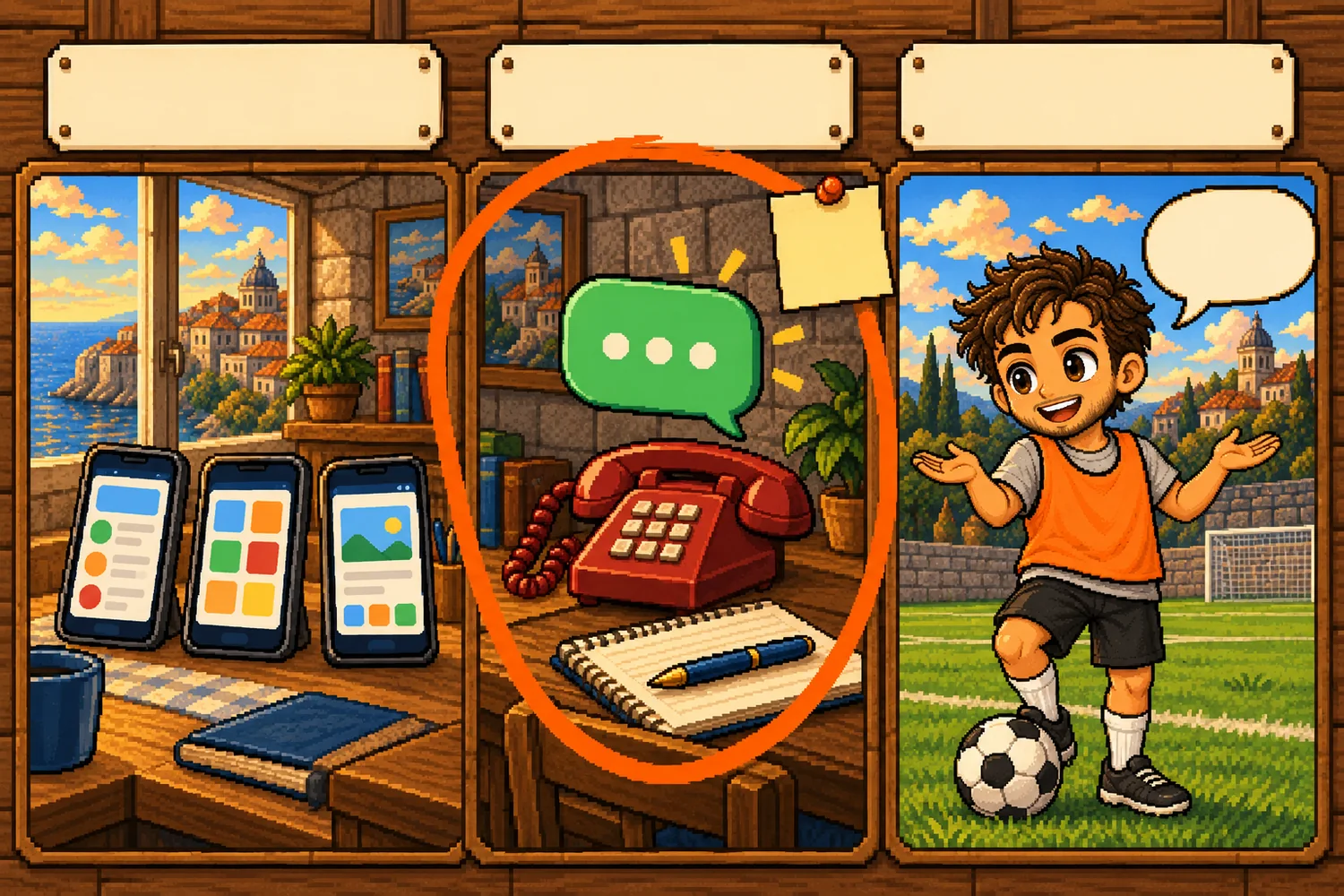 Similar appsWhat people use instead of an appDoing nothingwe'll just play 4 on 5the rival that matters
When you do your landscape review, look at all three. And ask yourself, honestly: does my app beat WhatsApp? Not on features (anything beats it on features). On laziness. Is it easier to use my app than to send a message to the group? If the answer is no, Nico is going to keep sending messages.
How to do the landscape review
I'm going to suggest four steps. An AI can help you with the first two. The last two you have to do yourself.
One: the list. Ask an AI to put together a list of apps and services that solve your app's problem, in your country and abroad. Today's AIs can search the internet, and they're pretty good at it. But watch out: sometimes they name apps that already shut down, or that never existed under that name, or that exist but don't do what the AI says they do. Treat the list as a starting point, never as a fact.
Two: the reviews. For every app on the list that actually exists, go to the store and read the reviews. Not the five-star ones, though. Those tell you nothing. Read the one-, two- and three-star reviews. The one-star ones are pure anger, sometimes unfair, but they tell you what hurts the most. The three-star ones are the best: they come from people who wanted to like the app and something got in the way. That's where your gap is.
An AI can help you summarize these too, if you hand it the reviews. But read a few yourself. Some things you only pick up from how a review is written, not from what it says.
Three: use them. Download the three or four most important ones and use each for fifteen minutes. Do what your user would do. For Falta Uno: try to book a field for Thursday at nine. Count how many taps it takes. Screenshot every screen. Write down where you hesitated, where it asked you for something you didn't understand, where you felt like closing it.
Four: talk to people. This is the part almost nobody does, and it's worth the most. Find five people who have the problem. Five is enough to start. And ask them about what they did, not what they would do.
The difference is huge. If you ask someone "Would you use an app to book fields?", they'll say yes, because they're being nice and saying yes costs them nothing. That answer is worthless. But if you ask "Tell me about the last time you organized a game," they'll tell you the truth: they did it over WhatsApp, they called two venues, one didn't pick up, and in the end they played anyway. That answer is gold.
There's a really good book about this called The Mom Test, by Rob Fitzpatrick. The idea behind the title is that you have to ask your questions in a way that even your mom, who loves you and would lie to spare your feelings, can't lie to you. Questions about the past, about facts, about money they've already spent. Never about the future.
For Falta Uno I talked to two kinds of people: organizers like Nico, and venue owners like Laura. And what the owners told me changed the app. Not one of them complained about bookings. They all complained about the same thing: last-minute cancellations, and empty fields during slow hours. I never would have found that in any app store.
The map
Once you have everything, the original book suggested placing the apps on a map to see where yours fit. I still do it, on a sheet of paper, with two axes.
Pick the two axes that matter most to you. For Falta Uno I picked:
- Left to right: for the player or for the venue.
- Bottom to top: simple (does one thing) or full-featured (does a lot of things).
Then you place each competitor as a little dot with its name. Include WhatsApp, the phone call and Laura's notebook. They're competitors even though they're not apps.
Looking at Falta Uno's map, two things jump out. First: the apps for venues are full-featured and heavy, built for someone sitting at a computer, not for Laura at the snack bar. Second: on the player side, the simple option is WhatsApp, and the apps that try to replace it turn into soccer social networks and fill up with stuff Nico doesn't want.
The gap is at the bottom, in the middle: something simple that serves both sides at once. That's where Falta Uno goes.
Don't look for a spot where nobody is. Look for one where the people already there are getting something wrong, and it hurts your user.
What to copy
The landscape review isn't only for finding what everyone else gets wrong. It's also for seeing what they all do the same way.
In 2019 I said something that's still true: if people of all ages are going to use your app, it's a good idea to copy the shape of the apps everyone already uses. If WhatsApp, Instagram and your banking app put certain things in certain places, your user has already learned where to look for them. Don't make them learn it all over again.
So, from your landscape review, also write down what keeps repeating. If every booking app shows times as a grid of little buttons by the hour, people probably already understand that grid. Don't invent a roulette wheel.
Innovate on what your app solves. Copy everything else.
Your homework for this chapter
- Ask an AI for the list of competitors. Check that each one exists.
- Read the one-, two- and three-star reviews of the four most important ones. Write down the complaints that keep coming up.
- Use those four apps for fifteen minutes each, doing your app's main task. Count taps. Take screenshots.
- Talk to five people who have the problem. Ask them about the last time, not the next time.
- Draw the map with two axes. Mark the gap.
- Write down what you're going to do differently and what you're going to copy.